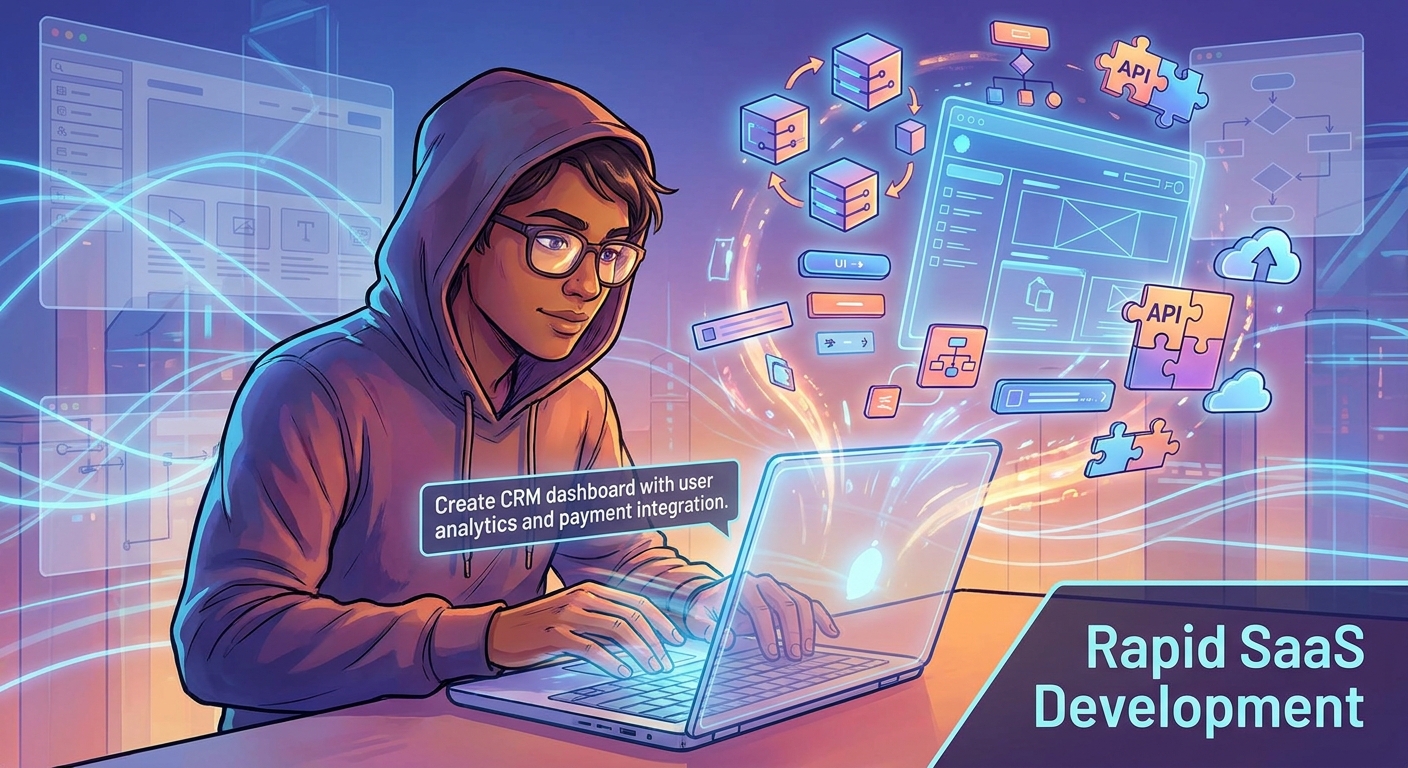
The landscape of software development is undergoing a profound transformation. In an era dominated by Artificial Intelligence, the ability to launch sophisticated, AI-powered Software as a Service (SaaS) products is no longer exclusive to those with deep coding expertise. By 2026, the convergence of mature no-code/low-code platforms and accessible AI APIs will empower a new generation of founders and solopreneurs to bring their innovative AI SaaS ideas to life without writing a single line of code.
This article provides a comprehensive guide to the essential tools, ideal tech stack, and practical methodologies for building and deploying an AI-driven SaaS application rapidly and efficiently, leveraging the power of generative AI and no-code solutions.
The No-Code/Low-Code Revolution for AI SaaS
Why No-Code for AI?
No-code development offers an unparalleled advantage: speed. For founders, this translates to faster time-to-market, enabling quick validation of ideas, reduced development costs, and the ability to pivot rapidly based on user feedback. When combined with AI, no-code empowers non-technical entrepreneurs to focus intensely on the problem they are solving and the unique value proposition, rather than getting bogged down in complex coding challenges.
Shifting Landscape by 2026
By 2026, we anticipate no-code platforms will have even more robust, native integrations with leading AI models. The 'prompt engineering' skill, the art of crafting effective instructions for AI, will become as crucial as traditional database design. Platforms will offer sophisticated visual interfaces for connecting to AI services, managing AI outputs, and automating AI-driven workflows, making the entire process intuitive and accessible.
Essential No-Code Tools for Your 2026 AI SaaS Stack
Building an AI SaaS without code requires a carefully selected stack of tools, each excelling in its specific domain while offering seamless integration capabilities.
Application Building & Data Management
- Bubble: The powerhouse of no-code, offering unparalleled flexibility for building complex web applications with rich UIs and custom workflows. It’s ideal for dynamic AI SaaS products requiring intricate user interfaces and backend logic.
- Webflow: While primarily a website builder, Webflow is excellent for creating polished landing pages, marketing sites, and static elements of your SaaS, integrating beautifully with other no-code tools for dynamic content.
- Airtable: More than just a spreadsheet, Airtable functions as a flexible, relational database that can power your SaaS backend, storing user data, AI inputs, and outputs. Its automations and views are incredibly powerful.
- Xano (Low-Code): For more complex backend logic and scalable API creation, Xano provides a robust low-code backend builder. It allows you to create custom APIs that can directly interact with AI models and serve data to your frontend.
- Supabase/Firebase (Low-Code): Open-source and Google-backed alternatives, respectively, offering real-time databases, authentication, and serverless functions, ideal for scalable AI-driven applications.
AI Integration & Workflow Automation
This is where the magic happens, connecting your application logic to powerful AI models.
- OpenAI API (GPT-4, DALL-E 3, Whisper): The gold standard for generative text, image creation, and speech-to-text. These APIs are accessible via HTTP requests, making them straightforward to integrate with no-code tools.
- Anthropic API (Claude): Another leading large language model, offering different strengths and safety profiles, available for integration.
- Hugging Face: A vast repository of pre-trained models for various AI tasks (NLP, computer vision). Many of these can be integrated directly or via specific APIs.
- Zapier/Make (formerly Integromat): These automation platforms are the glue of your no-code AI stack. They allow you to connect your frontend/backend tools to AI APIs without code, setting up triggers and actions to process data through AI models and return results. They facilitate the 'application generation via prompts' by orchestrating AI calls based on user input.
Payment & User Management
- Stripe: The industry standard for payment processing, easily integrated into Bubble or other no-code platforms to handle subscriptions and one-time payments.
- Auth0/Bubble's Native Authentication: Robust solutions for managing user sign-ups, logins, and access control.
Methodologies for Rapid AI SaaS Development
Building without code doesn't mean building without strategy. These methodologies are crucial for success.
The Power of Prompt Engineering
Mastering prompt engineering will be your most valuable skill. Learn to craft clear, concise, and context-rich prompts that guide AI models to produce desired outputs consistently. This involves iterative testing, understanding model limitations, and exploring few-shot learning techniques within prompts.
Design Thinking & User-Centricity
Always start with the problem you're solving for the user. Employ design thinking principles to empathize, define, ideate, prototype, and test. No-code's agility perfectly complements an MVP (Minimum Viable Product) approach, allowing you to launch a core AI feature quickly, gather feedback, and iterate.
Iterative Prototyping & Testing
The speed of no-code enables rapid prototyping. Build, test, refine, and repeat. A/B test different AI prompts or integration workflows. Conduct user testing to ensure the AI output is genuinely valuable and integrated seamlessly into the user experience.
Integration & Automation First
From the outset, design your system with integrations in mind. Think about how data flows between your UI, database, AI model, and back. Leverage Zapier or Make to automate workflows, such as triggering an AI model when a new database entry is created or sending AI-generated content to a user.
Challenges and Considerations
While powerful, building an AI SaaS without code isn't without its considerations. Scalability can be a concern for extremely high-traffic applications, though no-code platforms are rapidly improving. Vendor lock-in, data privacy, and security require careful attention, especially when handling sensitive information with AI models. Furthermore, staying updated with the fast-evolving AI landscape will be a continuous effort.
Conclusion
The future of AI-powered SaaS development is incredibly bright for non-technical founders. By 2026, the sophisticated ecosystem of no-code and low-code tools, combined with increasingly accessible and powerful AI APIs, will democratize innovation like never before. With the right stack and methodologies focused on prompt engineering, user experience, and rapid iteration, you are empowered to transform your AI ideas into successful, scalable SaaS products without ever touching a line of code. The time to build is now.