AIaaS vs. SaaS: Understanding the Differences and When to Prioritize Each
Recently published | By our experts
The digital landscape is increasingly dominated by cloud-based solutions, and among them, Software-as-a-Service (SaaS) and AI-as-a-Service (AIaaS) stand out as pivotal models for innovation and efficiency. While often discussed in similar contexts, particularly with the proliferation of generative AI, these two service models cater to distinct needs and user profiles. Understanding their fundamental differences and appropriate use cases is crucial for businesses aiming to make strategic technology investments.
What is Software-as-a-Service (SaaS)?
SaaS refers to a software distribution model where a third-party provider hosts applications and makes them available to customers over the internet. Instead of installing and maintaining software, you simply access it via a web browser. SaaS applications cover a vast range of business needs, from CRM and ERP to project management and communication tools.
Key Characteristics of Traditional SaaS
Traditional SaaS platforms are typically:
- Fully Functional Applications: They offer a complete user interface and a suite of features designed for end-users.
- Subscription-Based: Users pay a recurring fee (monthly or annually) for access.
- Managed by Provider: The vendor handles all infrastructure, maintenance, updates, and security.
- Ready-to-Use: Minimal setup is required; users can often start working immediately after signing up.
SaaS with Embedded AI
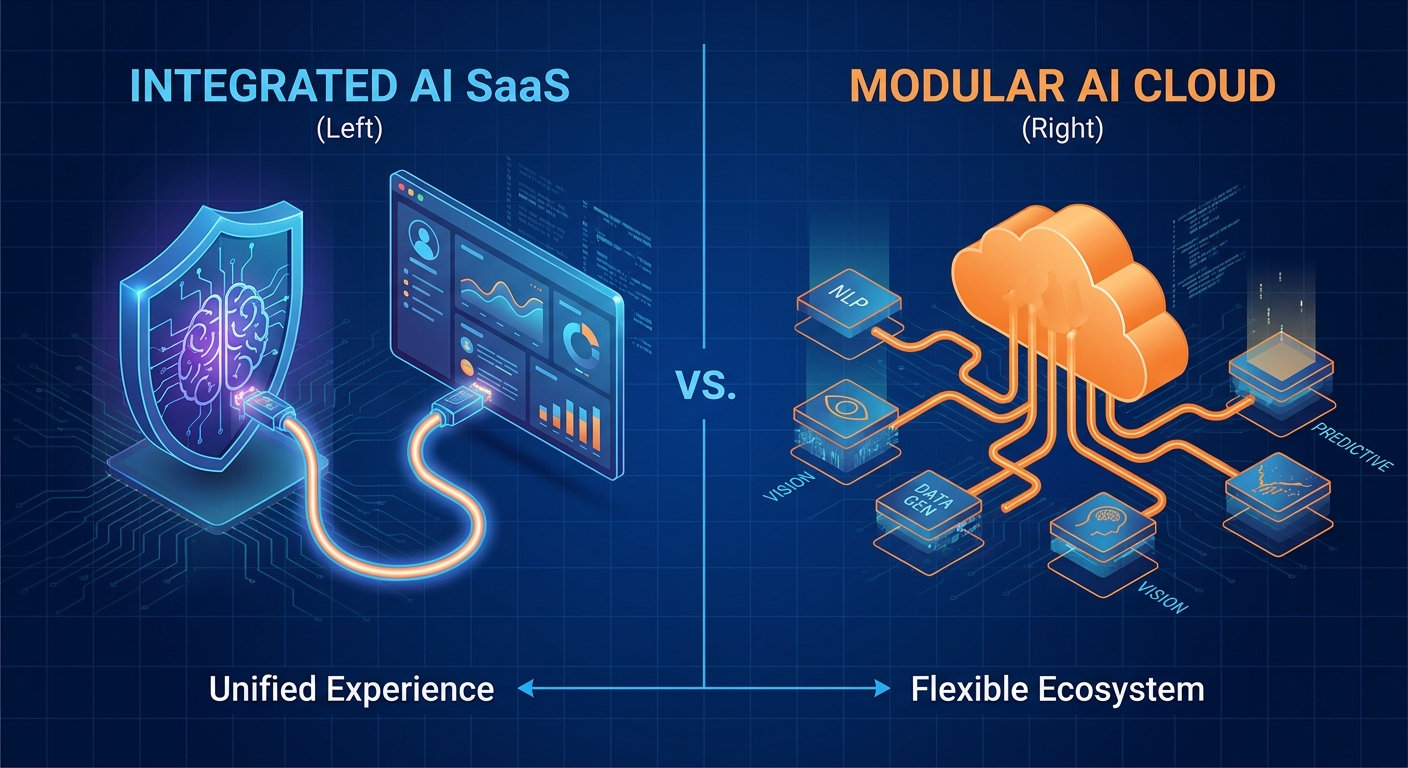
Many modern SaaS applications now integrate AI capabilities directly into their features. This isn't AIaaS; rather, it's AI *enhancing* an existing SaaS product. For instance, a CRM SaaS might use AI for lead scoring, a marketing SaaS for content recommendations, or a productivity SaaS for smart scheduling. The AI component is seamlessly integrated into the user experience, often operating in the background to improve functionality without requiring the user to interact with the AI model itself.
What is AI-as-a-Service (AIaaS)?
AI-as-a-Service (AIaaS) is a cloud-based offering that allows individuals and companies to experiment with and integrate pre-built AI models and algorithms into their own applications and processes without significant upfront investment in hardware, software, or specialized talent. It provides access to AI capabilities as consumable services, typically via APIs.
Key Characteristics of AIaaS
AIaaS is characterized by:
- API-Driven Access: AI functionalities are exposed through APIs, allowing developers to call these services from their custom applications.
- Focus on AI Models: The core offering is access to specific AI models (e.g., natural language processing, computer vision, machine learning models, generative AI).
- Flexible and Scalable: Users pay for what they consume (per API call, per query, per unit of data processed), making it highly scalable.
- Reduced Infrastructure Burden: The provider manages the underlying AI infrastructure, model training, and updates.
Types of AIaaS Offerings
AIaaS encompasses a broad spectrum of services, including:
- Generative AI Models: Such as large language models (LLMs) for text generation, image generation, code generation, etc.
- Machine Learning (ML) Platforms: Services for building, training, and deploying custom ML models.
- Specific AI Capabilities: Like speech-to-text, text-to-speech, sentiment analysis, object detection, recommendation engines, and predictive analytics.
Key Distinctions: AIaaS vs. SaaS
While both are cloud services, their core functions and target users differ significantly.
- Focus of the Service: SaaS delivers a complete, end-user application. AIaaS delivers specific AI capabilities or models to be integrated into *other* applications.
- Integration & Customization: SaaS is generally used as-is, with limited customization options (configuration). AIaaS requires integration by developers and offers immense flexibility to build highly customized solutions around the AI capabilities.
- Technical Expertise Required: SaaS is designed for business users with minimal technical knowledge. AIaaS typically requires developers or data scientists to integrate and fine-tune the AI services.
- Use Cases & Flexibility: SaaS solves a predefined business problem. AIaaS provides building blocks for creating new, AI-powered features or applications, allowing for broader and more innovative use cases.
When to Prioritize SaaS (with Embedded AI)
Opt for SaaS solutions, especially those with integrated AI, when:
- You need a specific business problem solved: If an off-the-shelf SaaS application addresses your core need (e.g., CRM, marketing automation, accounting).
- Ease of use is paramount: You want a ready-to-use solution that your team can adopt quickly without deep technical involvement.
- Compliance and data sensitivity are concerns: Reputable SaaS providers often have robust compliance frameworks and data security measures built into their applications.
- Your budget prioritizes operational expenses over development: SaaS typically involves a predictable subscription, avoiding large upfront development costs.
When to Prioritize AIaaS
Choose AIaaS when:
- You're building custom solutions: You need specific AI capabilities to power a unique application, product, or internal workflow not met by existing SaaS.
- You have developers or data scientists: Your team has the technical expertise to integrate APIs, train models (if applicable), and manage custom development.
- Experimentation and rapid prototyping are key: AIaaS allows quick testing of different AI models and approaches without heavy infrastructure investment.
- You need specialized AI models: For cutting-edge generative AI, highly specific computer vision tasks, or custom predictive analytics that require fine-tuning.
- Scalability for AI processing is critical: AIaaS providers offer robust infrastructure to handle fluctuating AI processing loads.
The Future: Convergence and Coexistence
The lines between AIaaS and SaaS are becoming increasingly blurred. Many SaaS providers are now leveraging AIaaS platforms to embed advanced AI features into their products, while AIaaS providers often offer SDKs and frameworks that simplify integration, making AI more accessible. Businesses might use a blend of both: a SaaS platform for core operations, augmented by custom AI applications built using AIaaS for specialized tasks.
Conclusion
Both AIaaS and SaaS are powerful paradigms driving digital transformation. SaaS, particularly with embedded AI, offers complete, user-friendly solutions for common business problems. AIaaS, on the other hand, provides the foundational AI components for developers and data scientists to build highly customized, intelligent applications. The optimal choice depends on your specific requirements, technical capabilities, desired level of customization, and strategic objectives. By understanding these distinctions, organizations can make informed decisions, leveraging the right service model to innovate faster and smarter in the AI-driven era.